
Being Discerning and Noticing Red Flags
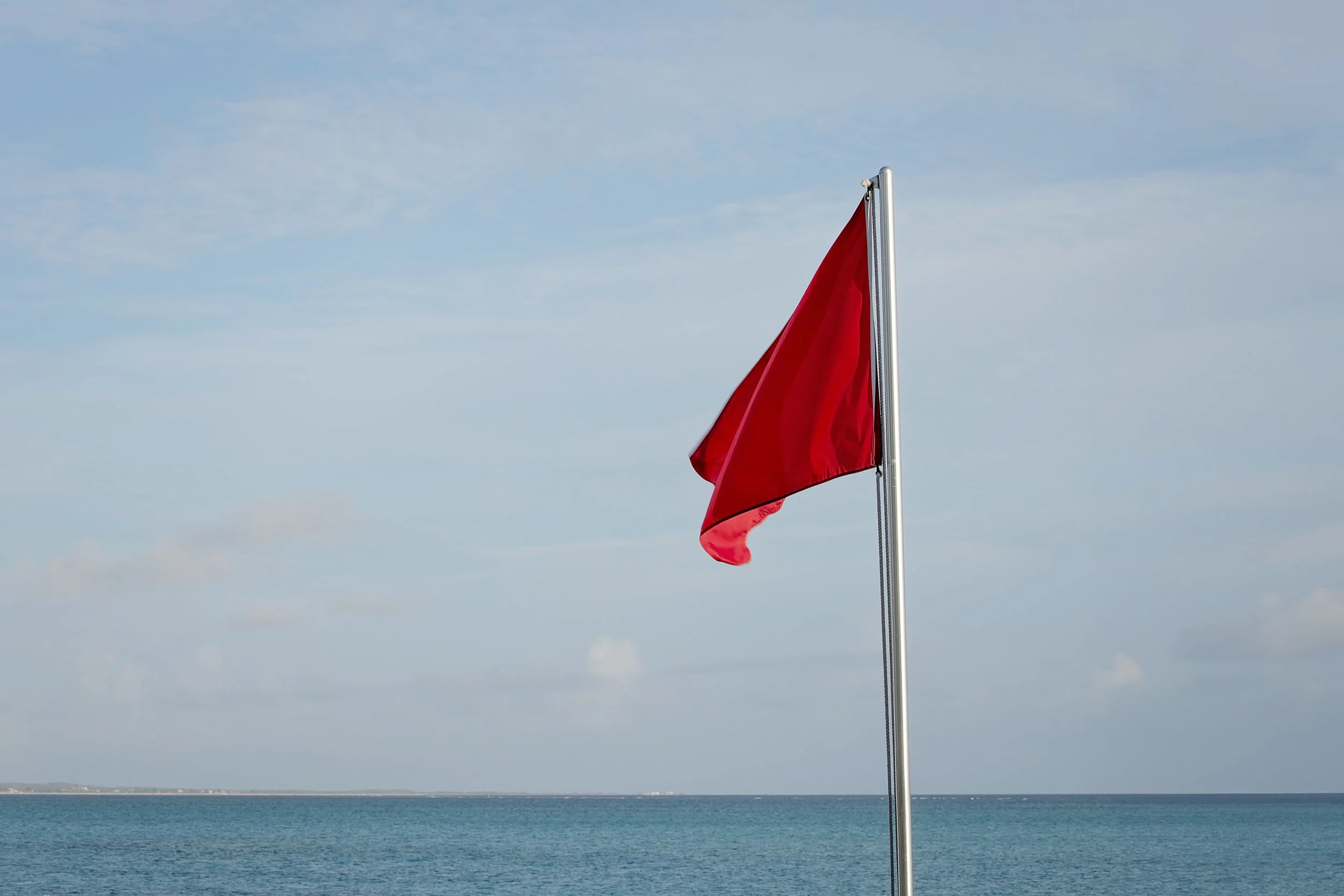
The word discernment is used in Christian settings often. Perhaps in today’s vernacular, one would say “noticing a red flag.” The implication is clear. A red flag is a warning. When flying on a beach, it is a warning that there are high surf and strong currents.[1] When used to refer to a person, it is a warning that there is something off about the individual and one should take caution. There are numerous passages in the Bible related to wisdom, warnings, and discernment.
Ephesians 5:6 (ESV)
Let no one deceive you with empty words, for because of these things the wrath of God comes upon the sons of disobedience.[2]
Empty words, confusing words, spiritually sounding words, but wrong words—that is the warning. Throughout the Scriptures there are warnings and instruction to be aware, to open one’s eyes, to pray for wisdom, so as not to be ensnared, or fall victim to a ruse, a con, or a false teaching.
The Greek word that is the origin of our term discern and its derivatives means “to distinguish, to separate out by diligent search, to examine.”[3]
Being able to discern truth is not only healthy and a sign of wisdom for the believer but fuels the confidence in the gospel needed when engaging in spiritual and evangelistic conversations. J. Gresham Machen, pastor and early 20th century theologian gave this warning, “False ideas are the greatest obstacles to the reception of the Gospel. We may preach with all the fervor of a reformer and yet succeed only in winning a straggler here and there, if we permit the whole collective thought of the nation to be controlled by ideas which prevent Christianity from being regarded as anything more than a harmless delusion.”[4]
The discerning Christian is strengthened in conversation by the Holy Spirit and God’s truth. Discernment fuels the Christian in his or her faith and ability to call out false teaching and teachers.
Most Christians are not enrolling in seminary classes or reading academic journals of theology. Yet, many are asking about the new church in their community that doesn’t have a denominational label upon it. They are wondering what the shifts in traditional mainline denominations mean. They wonder if the new podcast, online teacher, spiritual influencer, pastoral leader, or the group of religious people their loved one or friend has joined is legitimate. Of course, legitimacy is contingent upon one’s worldview. The biblical worldview is the right, narrow lens upon which to make such judgments.
There is a generation of parents and grandparents who grew up in a never-returning age of church life. The Bible Belt seemed authentic at a time. Fundamentalism and progressiveness entered the church houses and created lanes of belief, without many in the pews initially noticing. For many the terms conservative and liberal were just political labels, but even decades ago the differences were not as vastly noticeable regarding policy as now. For example, if you were to compare the party platforms adopted by the Democrats and Republicans in 1960, when John F. Kennedy and Richard M. Nixon were vying for the presidency, you will notice that the two platforms are so similar they are almost indistinguishable.[5] Of course now the platforms are easily distinguishable as divisions on cultural issues continue. Yet, conservative and liberal as related to theology seemed unimportant to many mainline protestants until the anti-biblical camel’s nose was too far under the tent and the denominations had to address the issues. Sadly, most mainline denominations caved to cultural trends while abandoning biblical truth.
Over the past few decades, churches have faced widening divides. Denominations have split based on cultural issues, biblical interpretation, and progressive ideology. While most American denominational groups split in the mid-1800s over the issue of slavery, many recent divides (from the 1970s to now) have centered on liberal theology, German higher criticism, progressive ideology, abortion, and the LGBTQ+ revolution.
Thus, just because a building has “church” and even a denominational moniker on its sign does not necessarily give all the information needed regarding a church’s theology and worldview.
Red flags start flying when certain things are noticed. A young college student from our church recently visited a Baptist church in the town where her university is located. Since the church was Baptist, and in the south, this seemed like a good option. Certainly, by her understanding, this church would be much like ours. Finding a church to attend while at school is vital and this student took the right initiative. However, during the sermon the pastor mentioned that the Trinity was not essential and that God is not truly one in three persons. There were some other things presented as well related to LGBTQ+ ideology and this student immediately thought, “This is not right.” The student continues to look for a college church, but that Baptist one is now off the list of consideration. I am thankful for her discernment.
Red Flag Authors
When an author is recommended one should do some research. Why do many Christian books have recommendations from other Christian leaders? Certainly, it is to bump sales by highlighting trusted, familiar names. When a new author is recommended, little is known about them and yet to see that their book is recommended by someone who is tested, trusted, and read goes far. Also, it is wise to check the publisher. Many biblically sound publishers exist and yet, there are some affiliated with groups, churches, and even cults that appear as spiritually and doctrinally sound but are not. In that vein, be aware that some publishing houses were very conservative and biblically sound decades ago but currently are not. Thus, the publishing date is important as well.
We often have older books donated to our church library. Many of these end up on the “take a free book” table in the room. Our librarians work with our church’s pastoral staff to determine if a book should or should not be on the table. We have had to remove some of these donated items due to the theological beliefs of the author, the publishing house, or the theme. Simply put, just because a book is a best-seller in the Christian sub-category in a bookstore does not mean that it is recommended, should be read, or shared. One friend said he never purchases a book with the author’s picture on the front. While there are many exceptions to that rule, I noticed a trend among the “please don’t donate or we will throw them away” category of books that featured the author’s mug on the front. Unless it is an autobiography, the red flag goes up.
Red Flag Churches
When it comes to churches, there are words and phrases on websites that can help one determine beliefs. These churches are not necessarily bad or non-Christian, but as a Baptist, phrases and words that mean one thing in our lane may mean something different in another. Thus, a church does not have to be Baptist to be legitimate. In fact, just because one is Baptist does not mean it passes the red flag test. However, for those seeking a church home, it is wise to do some research. I am often asked by church members who are moving to new cities or states, or who have children or relatives in another area to recommend a local church. In many cases it is easy as I know a good number of pastors and their churches. In other cases, I know no one in the area, so I must do a bit of website research. Here are just a few things I look for:
Who is the pastor?
Is the church shepherded by a man?
Is the church pastored by a husband-and-wife team?
What is the pastor’s biography?
Where did the pastor attend school? Did he go to seminary? Where? (Schooling and seminary are not required at all to pastor a church, but if a pastor does have a degree, or multiple degrees, from a seminary, it is wise to see which one it is as that seminary’s theology likely had a great influence on the pastor. There are, of course, many exceptions to this.)
Is the pastor accessible via email, phone, or through the church office?
Does the church have elders or associate pastors? Ministry directors?
Does the church’s site have its doctrine and statement of faith online and easy to find?
Are sermons available online? If so, how is Scripture used? What translation is used?
Does the church practice baptism by immersion?
Does the church use the term “water baptism” on its site? Why is this important? While not always the case, but often is, when a church states they practice “water baptism” which sounds much like what we do as Baptists by immersing in water, there often is a belief that in this church there is a secondary baptism called the “baptism of the Holy Spirit” which is often revealed through the ability of speaking in tongues. This is not always the case and even if it is, that does not mean the church is not Christian. It just means we would have significant differences in interpretation of Scripture and the work of the Holy Spirit. Baptists (mostly) believe in the baptism of the Holy Spirit because it is stated in Scripture, but we believe it occurs at the moment of salvation and has nothing to do with the gift of tongues.
Does the church baptize by immersion, but teach baptismal regeneration? This is a teaching that baptism in water is required for salvation, rather than is symbolic of one’s transformation. Churches of Christ, Christian Churches, and often those who are part of the Restoration Movement practice this. Many teach and believe it but never address it as baptismal regeneration. Often, they simply declare it as part of the Restoration Movement.
There are many other things to look for as well, but the wise person will do a bit of research prior to attending. This is one advantage of the interconnectedness of the internet.
Red Flag Cults
Red flags and discernment show up regarding non-Christian, but Christian-appearing religious groups and cults as well. There has been much reported recently regarding the “Chrisitianization” of the Church of Jesus Christ of Latter-day Saints (The Mormons) as a marketing practice in our nation and community. Jehovah’s Witnesses continue to have a strong presence. The list of such groups continues to grow and depending on where one lives, the influence of one group may be stronger than others. In Clearwater, Scientology is strong. The End-Timers still exist in Lake City. The Community of Christ (the rebranded Reorganized Church of Jesus Christ of Latter Day Saints) is in the Midwest, and other such churches have regional influence.
Warning – Misused Discernment May Lead to Pride
There is a danger of claiming discernment to a degree that one becomes negative, over-the-top judgmental, and ultimately disillusioned with every group, church, and person they encounter. Some slide into the self-appointed polemicist role for all Christians and people. This would be a red flag of self-pride, and one should pray for wisdom and strength to not fall into that trap.
When it comes to those red flags, praying for God to bring clarity is needed. That new church in the community may not have a denominational tag on the sign, but once one looks at their doctrinal statement of faith, listens to sermons preached, and with a discerning eye investigates the church, one may find it to be healthy, strong, and biblically sound.
Of course, the opposite could be true as well.
People have been drawn to the largest, loudest, friendliest groups for years.
One does not become versed in truth by studying counterfeits. Yet, the more one studies the Word of God, worships together in a gospel-centered church, and prays for wisdom, the gift and practice of discernment grow. Red flags appear when something is off and the wise Christian should take note.
Be careful little eyes what you see and what you read. Be careful little ears what you hear.
Romans 12:2 (ESV)
Do not be conformed to this world, but be transformed by the renewal of your mind, that by testing you may discern what is the will of God, what is good and acceptable and perfect.[6]
____________________
[1] “Beach Warning Flags.” Volusia County Government Online, www.volusia.org/services/public-protection/beach-safety/beach-warning-flags.stml. Accessed 7 Jan. 2026.
[2] The Holy Bible: English Standard Version (Wheaton, IL: Crossway Bibles, 2025), Eph 5:6.
[3] GotQuestions.org. “Home.” GotQuestions.Org, 12 July 2012, www.gotquestions.org/Bible-discernment.html.
[4] Mache, J. Gresham. “Christianity and Culture.” Princeton Theological Review 11 (1913): 7.
[5] Mohler, Albert R. “The Most Important Election of Your Lifetime?: Yes, and the next One Will Be Even More so. Here’s Why.” AlbertMohler.Com, 26 Jan. 2023, albertmohler.com/2022/12/07/the-most-important-election-of-your-lifetime-yes-and-the-next-one-will-be-even-more-so-heres-why/.
[6] The Holy Bible: English Standard Version (Wheaton, IL: Crossway Bibles, 2025), Ro 12:2.