
Sophie Has a Point
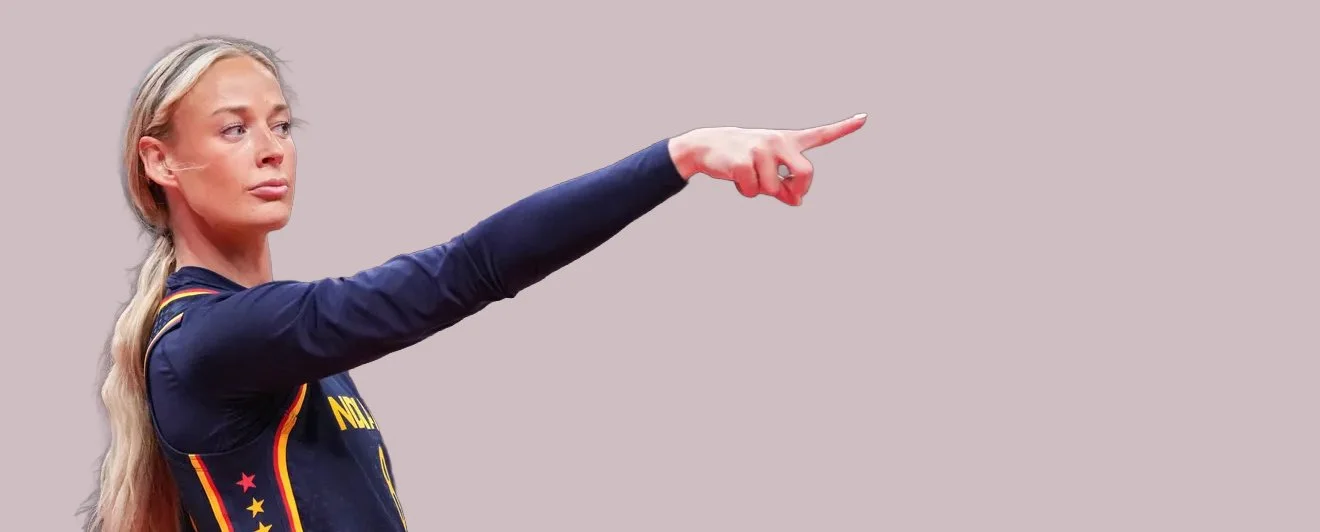
Original Photo from USA Today & IndyStar
In 1997 a new professional sports league launched in the United States. With the rise in popularity of women’s basketball at the collegiate level, most notably due to the success of the Tennessee Lady Vols and the Connecticut Huskies, the time seemed right to provide a professional basketball option in the states. For years, women who wished to continue playing post-college, leagues in Europe and Asia provided the only option. The NBA provided funding. Advertising began to flood the sports channels and magazines with the tag line “We Got Next.” The summer pro league began with legends such as Lisa Leslie, Cheryl Swoopes, and Rebeca Logo headlining.
Over the years, the league has struggled financially. Several teams have relocated, rebranded, and some have been retired. Recently, for the first time, the WNBA generated enough revenue to trigger revenue sharing with players. This occurred in 2025.[1] The surge in popularity has led the league to add more teams with plans for expansion in the future. While the women’s professional league lags far behind the NBA and other professional leagues, the upturn has been encouraging for female athletes.
There are various reasons for the uptick in popularity. Most notably has been the addition of star player Caitlin Clark of the Indiana Fever. While other players, sportscasters, and numerous talking heads have sought to downplay her impact, the numbers do not lie. Clark’s presence led to larger crowds in Indianapolis as well as at opposition stadiums. In her first year, the Fever averaged over 3,000 more than any other franchise when on the road.[2]
Clark is not the only popular Fever player. Her teammate Sophie Cunningham has been in the league since 2019 and in just over a year, her name recognition has soared. In 2025 Cunningham joined the Fever after being drafted by and playing for the Phoenix Mercury. She soon became a fan favorite. Her notoriety increased primarily due to her role as an enforcer or perhaps more accurately, a protector. However, Cunningham has stated that she is not an enforcer. She simply desires to do whatever the team needs.
The Point
You do not have to be a basketball fan, much less a women’s basketball fan, to be aware of “pointing Sophie.” During a June 22, 2026, game against her former team, a skirmish occurred and as the referees were sorting out the issues, Sophie began pointing toward Mercury player DeWanna Bonner. Bonner apparently said, “Don’t point at me!” and that led Sophie to continue pointing for 22 seconds. The image went viral and Cunningham’s popularity skyrocketed.
Another Point
In recent days, Sophie made clear that as a woman with a platform in the arena of sport, she feels obligated to speak out regarding the safety of young girls and women. In an article published by ESPN, she stated, “I think that I am here to extend love. But I also think with that love is truth, being honest. And I want to protect young girls in a locker room, or young girls in sport who shouldn’t have to go against biological men.”[3]
And with that, the public maelstrom began.
To dare to speak against the movement that has sought to legitimize the transgender movement has made Cunningham a target for protests and more. In recent years when such pushback has come, many have backtracked on what they have said. Likely, most of the backtracking is due to public image pressure rather than personal beliefs. Nonetheless, Cunningham has stood firm thus far. Perhaps she has embraced the role of protector in this avenue?
While Cunningham remains firm, the league seems to be struggling to respond. League and team representatives have been asked if transgender women would be welcome in the league and the weak responses drip with progressive verbiage that ultimately avoid direct answers while couching all responses with “We love all people.” No one asked if all people were loved. What has been asked relates to whether those who identify as transgender women (biologically male) are eligible to play in the women’s league.
Rallies have been held. More are scheduled. Protests against Cunningham continue. Coaches and other players are expressing their pro-transgender beliefs. Cunningham has been booed loudly in stadiums away from home. She seemingly has embraced the uproar claiming that she loves when opposing fans boo her. That’s a basketball response.
Perhaps the most newsworthy moment occurred recently when the Fever played in Seattle against the Storm. Two teenage girls were seated near the court with a placard declaring their appreciation for Sophie Cunningham’s stance. The co-owner of the team confronted them, yelling that they were “expletive insane.” The league has suspended the owner from attending the next five games and the team has put out an apology statement. However, the deed was done. The beliefs were on display. The divide is real.
Final Point
The challenges facing female athletes are not insignificant. Some declare those who believe that men should not enter female locker rooms or compete against women in definitive women-only leagues to be hateful, legalistic, and out of touch. Yet the number of female athletes who have expressed that men should not be allowed to compete in women’s only leagues are as varied ideologically as Riley Gaines and Martina Navratilova.
The Sophie Cunningham story seems to be about basketball, but there is more. The story is larger. Long after people stop protesting Sophie, the issue will remain. In some sense, the camel’s nose is under the tent now and the issues must be addressed.
Clarity is our friend. Clarity is not what those affirming transgender ideology are offering. Speeches can be given. Statements can be released. Opinions can be posted. However, what remains clear is that everyone actually knows there is a difference between a man and a woman biologically. Those who often lean into “believe the science” must admit that the science, not to mention created order, affirms that males and females are different. One can pretend to not know what the W in WNBA means, but we all know it does have a meaning. One that is unchangeable.
This is the point.
____________________
[1] Barnes, Katie, and Multiple Authors. “Union: WNBA Made Enough Money for Revenue Sharing.” ESPN, ESPN Internet Ventures, 23 Feb. 2026, www.espn.com/wnba/story/_/id/48014819/union-wnba-made-enough-money-revenue-sharing.
[2] “Caitlin Clark Effect Continues to Drive Fever Road Attendance.” Sports Business Journal, Sports Business Journal, 8 June 2026, www.sportsbusinessjournal.com/Articles/2026/06/08/caitlin-clark-effect-continues-to-drive-fever-road-attendance/.
[3] Grossman, Hallie. “Love Her or Hate Her, Sophie Cunningham Won’t Be Ignored.” ESPN, ESPN Internet Ventures, 21 July 2026, www.espn.com/wnba/story/_/id/49306657/sophie-cunningham-finger-point-indiana-fever-wnba.
[1] Stolberg, Sheryl Gay. Fauci Repeatedly Refuses to Answer Senators’ Questions at Volatile Hearing - The New York Times, 29 July 2026, www.nytimes.com/live/2026/07/29/us/trump-news-fauci-hearing.
[2] Daniel, Ari. “Rand Paul Releases Anthony Fauci’s Pandemic-Era Diary Notes. Here’s What They Tell Us.” NPR, NPR, 28 July 2026, www.npr.org/2026/07/27/nx-s1-5909531/rand-paul-anthony-fauci-coronavirus-diary-lab-leak-origin.
[3]The World and Everything in It: July 29, 2026 | World, 29 July 2026, wng.org/podcasts/the-world-and-everything-in-it-july-29-2026-1785263395.
[4]The World and Everything in It: July 31, 2026 | World, 31 July 2026, wng.org/podcasts/the-world-and-everything-in-it-july-31-2026-1785442740.
[5]The World and Everything in It: July 31, 2026.
[6]The Holy Bible: English Standard Version (Wheaton, IL: Crossway Bibles, 2025), Pr 29:5.