
The Multigenerational Church and Aging Boomers

The demographic cliff is upon us. This has been a hot topic for educators and demographers for some time. I wrote about this reality a few months back.[1] (Click here for that article) Recently Ryan Burge, Professor of Practice at the Joh. C. Danforth Center at Washington University in St. Louis has been sharing results of recent studies related to religion, evangelicalism, and church attendance in the United States. Burge is the author of numerous books. A few years ago, I was able to attend a conference where data and information was presented from the book he coauthored with Jim Davis and Michael Graham, The Great Dechurching: Who’s Leaving, Why Are They Going, and What Will It Take to Bring Them Back? The conference was eye-opening and the data interesting, if not shocking.
Opinions On Church Attendance
Many churches with long histories and visible decline in attendance populate our communities. The church I pastor is one such church. Founded in 1921 and with steady growth that mirrored the community’s expansion continued for decades. Once the Baby Boomers (born 1946-1964) came upon the scene in post-WW2 America, our suburban community experienced what many others did throughout the United States.
The Boomers grew up as the most optimistic generation in American history for numerous reasons:
Kids knew their grandparents and sometimes great-grandparents due to increasing life spans.
Penicillin and vaccines eradicated and controlled long-standing health threats.
Television constantly marketed to, captivated, and entertained them.
The postwar economy boomed.
The middle class developed and prospered.
The optimism for the future was great.[2]
That optimism soon shifted with the impact of the Vietnam War, Watergate, the Sexual Revolution, the energy crisis, and more.
Not unlike other suburban churches, ours experienced an era of growth beginning in the late 1980s despite some tragic, traumatic, and sinful occurrences within our church body.[3] (I wrote about this era here.) Growth was expected as each year our numbers increased. More senior adults, young families, more children, more teenagers, and more preschoolers were attending.
Then, numbers started to decline.
Leadership was concerned while simultaneously being blamed. New churches were beginning and hundreds would move their church membership to the latest church in waves. Other churches in our community were experiencing the same and some of their members would shift to our church. This was the all-too-common “sheep swapping” that defined much of what was titled church growth for an era.
Often a church’s decline in attendance is not noticed immediately. To paraphrase an Ernest Hemingway quote, “How did your church die?[4] Two ways. Gradually, then suddenly.”[5]
Far too often I have met with church leaders lamenting the coming closure of their neighborhood churches. The question asked is “When did the decline begin” and the answers are “We don’t know a specific time. It seems that one day we looked out and realized that we were doing more funerals than baby dedications and suddenly, there were just a few in the building.”
Gradually, then suddenly.
No local church is immune to change and shifting demographics. Many Monday morning armchair quarterbacks have opined on the state of the church in America today with various thoughts on what should have been done in the past. The past certainly should not be ignored, but the wise looks at the present and prayerfully considers where God is leading for the next step.
The Boom Is Coming
Demographer Hadyn Shaw has updated his book Sticking Points focused on the fact that for the first time in American history, five generations are simultaneously in the workforce. Generational dynamics are very real and while often they become stereotypes, for the most part the defining characteristics of a generation are distinct. Different generations in American culture tend to view the world differently. Shaw has compared how generations think and ways to connect with each by giving steps for leading, rather than managing generational differences.[6]
The Multigenerational Church
No church is healthy that only consists of one age group. While youth provide energy and vigor, the older generations provide wisdom and experience. The church, from its genesis in the New Testament benefitted from the varied generations. In fact, it seems this is God’s plan. The reason that churches should celebrate faith that passes from one generation to the next is obvious. The local church that is not multigenerational dies.[7] Gradually then suddenly.
Research has been seeking to find trends in the area of generational church attendance for years. While the reality of the downturn in attendance is clear, the reasons seem to be varied. In 2010, roughly 40 percent of Americans said they had attended worship in the previous seven days.[8] That data is now sixteen years old and in this current age, trends move quicker.
It does not take a sociologist to look around most churches and realize that there are more empty seats than in the past (in many cases) and often a lopsided gathering of different generations.
Aging is strange. Suddenly, something that seems like it happened just a year or two ago actually occurred over fifteen years ago. I remember when this reality first set in with me. I was teaching teenagers a Bible study back in the early 2000 and thought I would use a “where were you when” question as an opening illustration. I confidently asked, “Do you remember where you were when the Space Shuttle Challenger exploded?” The students looked confused and finally one said to me “Dave, that was four years before I was born.”
Suffice to say, I was reminded at that moment how quickly time moves as one ages.
Now, The Tipping Point
Just last week I saw some data presented by Ryan Burge, one of the authors I mentioned earlier. This latest data regarding church attendance among generations as divided by denominations is interesting.
The term tipping point was used by Burge to describe what is coming. In 2000 author Malcolm Gladwell’s debut book Tipping Point: How Little Things Can Make a Big Difference became a best seller. Gladwell opened with using Hush Puppies, the popular brushed suede shoes that were everywhere in the 1970s was all but dead in the mid-1990s until it was discovered that club goers in New York had begun wearing them and suddenly, what was dead was renewed. Suddenly a shoe that was only selling 30,000 pairs annually and on the verge of elimination saw a surge. New marketing strategies were put in place, and while some would say the makers of the shoes had a plan that finally came to fruition, the truth was they stumbled into a movement. Shoe sales increased and in 1995 over 430,000 shoes were sold. The following year over 1.5 million pairs. This was not a shoe-growth strategy, but a step (pun intended) toward a tipping point where popularity grew, response was ready, and the shift in strategies developed.[9]
In the case of Hush Puppies, the tipping point moved toward a positive result. However, a tipping point can also shift quickly toward the negative. The wise should take this to heart.
Burge’s research shows the number of Baby Boomers who attend church regularly in the major evangelical denominations and networks in the United States and the numbers are eye-opening. Burge stated this on X, “A lot of folks assume that many Protestant denominations will just slowly decline over the next few decades. That's not what is going to happen. The Boomers are propping most of them up right now. When they age out, it's gonna get bad. Really fast. No one is ready.”[10]
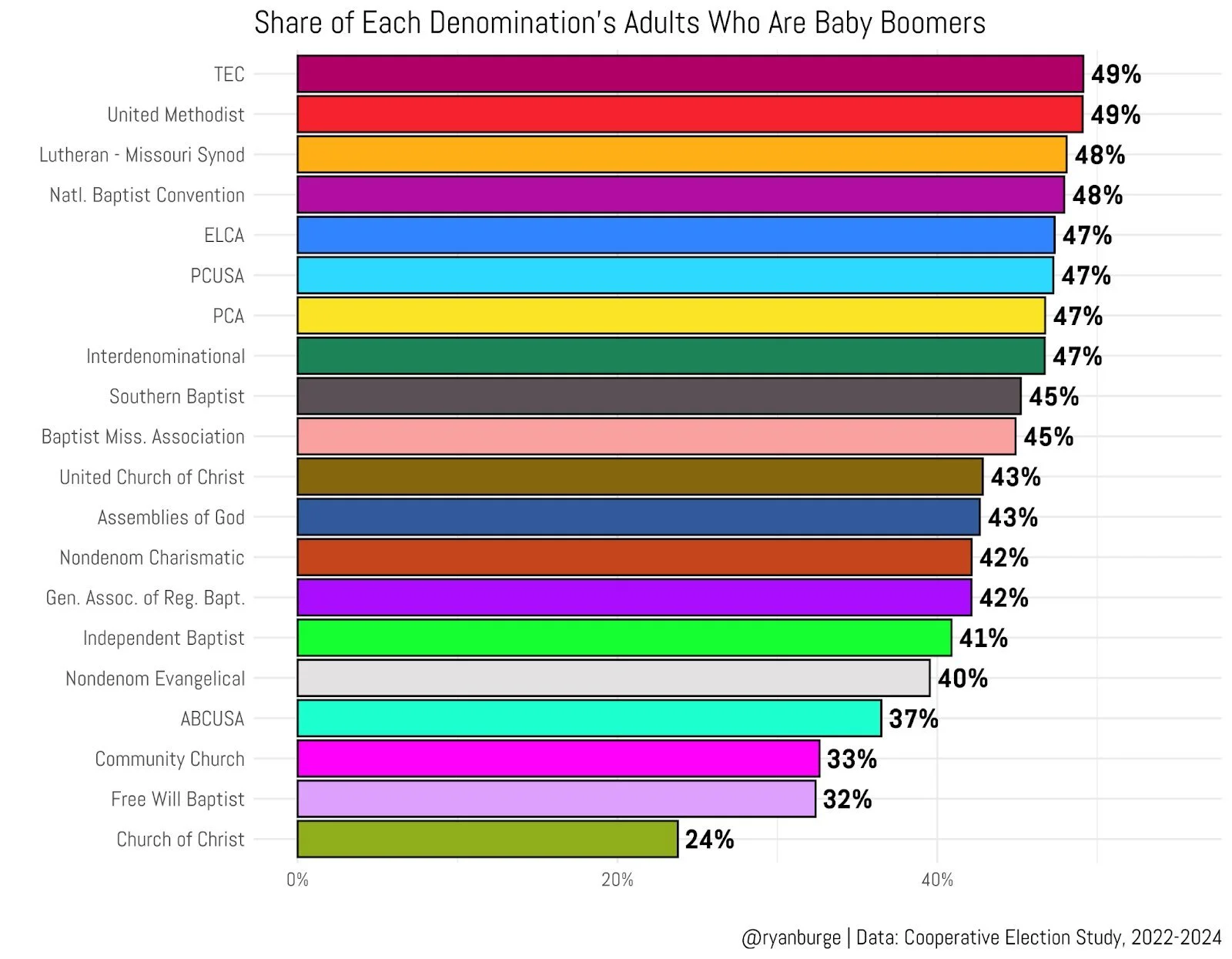
For Southern Baptists, the percentage of Baby Boomers is 45 percent. With Southern Baptists being one of the largest Protestant groups in America, this is a significant percentage. Just to put this in perspective, according to Pew Research, the number of Boomers in the United States in mid-2024 was approximately 67 million. That’s only 20 percent.[11] This has huge implications for our church and the entire Southern Baptist Convention.
The tipping point is upon us and with more funerals than baby dedications, the reality is setting in. Communities change, especially suburban and regional ones. People groups shift. The area of a community that was full of young families with children will soon be full of median age adults and visiting grandchildren. This is the joy of maturation, but as many city and suburban areas show, the homogeneity of an area can create opportunities and challenges.
No Settling
Certainly the church must never abandon the clear call of God as revealed in the inerrant Scriptures. Focused, gospel-centric preaching and ministry must remain central. Churches and denominations who have abandoned such have discovered a slight bump in attendance perhaps due to social gospel or community service foci, but eventually it leads to a slippery slope that provides a theological nothing-burger to a spiritually starving crowd. As one pastor told me decades ago, “Theologically liberal churches do not grow because they offer nothing of substance.”
In our current era of “big-box” franchised churches, the value of the local, gospel-centered, in-person church remains. Yet, to ignore the reality of the coming tipping point will leave many wondering what happened.
The church I pastor continues to seek God’s lead in how to most effectively reach the people whom he has placed in our field. A denominational leader told me about twenty years ago that our church was perfectly positioned to reach a people group that died twenty years prior. To tell the truth, that hurt. I’m not sure if I was offended because it seemed rude (he wasn’t seeking to be rude) or that I knew it to be true.
Sometimes just seeing the numbers are used by God to shake us into asking the right questions. The fact is we can get the right answers, but if we’re asking the wrong questions what good is that? Right answers to wrong questions do nothing.
I am not looking for a silver bullet. I do not believe we need a consultant to reveal some secret truth that will result in increased attendance. I cringe at stepping into another “church growth strategy” but I do know that being as the men of Issachar, it is to our advantage to understand the times.
Thus, I pray for wisdom from God, knowing he is not looking at charts or survey results. I firmly believe that God placed our church and many others in their unique and specific areas for his glory.
Rest assured, Christianity is not in trouble. God is not panicking. The church will prevail. The local church may change, but that has always been the case.
In the meantime, may we blur the lines between generations and seek to love one another well, reach others intentionally, and glorify God eternally.
And may we be faithful stewards of our facilities, community impact, and gospel-giftedness so that His kingdom may increase.
____________________
[1] Tarkington, David. “The Demographic Cliff.” David Tarkington, David Tarkington, 7 July 2025, davidtarkington.org/read/2025/demographiccliff.
[2] Shaw, Haydn. Generational IQ: Christianity Isn’t Dying, Millennials Aren’t the Problem, and the Future Is Bright (Carol Stream, IL: Tyndale House, 2015), 45.
[3] Tarkington, David. “Pastoring a Church Marred by Sexual Abuse.” David Tarkington, David Tarkington, 20 June 2019, davidtarkington.org/read/2019/sex-abuse.
[4] In his book, Hemingway’s character Matt Campbell was asked about his money troubles “How did you go bankrupt?” and gave the answer that is often quoted in this article.
[5] Hemingway, Ernest. The Sun Also Rises: The Authorized Edition (New York, Scribner, 2006).
[6] Shaw, Haydn. Sticking Points: How To Get 5 Generations Working Together in the 12 Places They Come Apart (Carol Stream, IL: Tyndale Momentum, 2020), xxi.
[7] Chappell, Bryan. The Multigenerational Church Crisis: Why We Don’t Understand Each Other and How to Unite in Mission (Grand Rapids, MI: Baker, 2025), 18.
[8] Gallup, “How Religious Are Americans?”
[9] Gladwell, Malcolm. Tipping Point: How Little Things Can Make a Big Difference (New York: Back Bay Books, 2002), 1.
[10] @ryanburge. “Share of Each Denomination’s Adults Who Are Baby Boomers.” X, 29 Jan. 2026. https://x.com/ryanburge/status/2016856599130681439?s=20
[11] Fry, Richard. “The Oldest Baby Boomers Turn 80 in 2026.” Pew Research Center, Pew Research Center, 9 Jan. 2026, www.pewresearch.org/short-reads/2026/01/09/the-oldest-baby-boomers-turn-80-in-2026/.